
"You cannot just pick Rs 8 lakh out of the thin air and fix it as a criteria. There has to be some basis, some study. Tell us whether any demographic study or data was taken into account in fixing the limit. How do you arrive at this exact figure? Can the Supreme Court strike down the criteria, if no study was undertaken?" the Supreme Court asked.

After bumbling for years since 2014, the Modi government seems to believe that massive government expenditure will lead us to prosperity supported by 'seat-of-the-pants' decision-making, observes Debashis Basu.

Contributions to mutual fund schemes through systematic investment plans or SIPs remain unfazed from the market volatility in 2022 with inflow growing to Rs 1.5 lakh crore in 2022, a surge of 31 per cent from a year earlier, due to higher retail participation. In comparison, an inflow of Rs 1.14 lakh crore through the route was registered in 2021 and Rs 97,000 crore in 2020, data with the Association of Mutual Funds in India (AMFI) showed. Going ahead, SIP numbers are expected to continue to remain strong in 2023 as investors are increasingly appreciating the importance of regular investing through the route, Kaustubh Belapurkar, director - manager research at Morningstar Investment Adviser India, said.

After years of being sequestered by the pandemic, some intrepid travellers are planning to settle their score with the novel coronavirus. With fewer or no travel curbs, they are eager to get back on the road, again. Hotels and tour operators, too, are eager to shed excess Covid baggage. And this year's Diwali promises to add that extra layer sparkle with the introduction of new flights.

The Supreme Court on Friday said there should be a robust mechanism to ensure that the interests of Indian investors are protected in the stock market and sought views of the Centre and market regulator SEBI on PILs alleging exploitation of innocent investors and "artificial crashing" of the Adani group's stock value.

'The Chinese devalued the yuan initially but then stopped'.

The highlights of the export package was the increase of drawback rates by an average 2 percentage to 3 percentage points with retrospective effect from April 1.

Exporters on Thursday demanded fiscal incentives, tweaking in customs duties on certain products and credit at affordable rates in the forthcoming Budget to boost exports and create jobs. In a pre-budget virtual meeting with Finance Minister Nirmala Sitharaman, the Federation of Indian Export Organisations (FIEO) said the depreciation of the rupee against the US dollar is affecting exports' competitiveness and the sector requires more support. "Creation of employment is the biggest challenge faced by the country...We would urge the government to provide fiscal support to units which provide additional employment in the export sector," the exporter's body said.
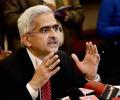
Reserve Bank Governor Shaktikanta Das on Monday said despite the latest headwinds arising from the Jackson Hole summit leading to extreme volatility, our banking system and financial markets are strong enough to withstand such pressures. Taking the markets by surprise, US Fed chair Jerome Powell had told the annual Jackson Hole summit of central bankers and economists last week that he would have to keep raising federal fund rates to tame inflation, which remains the biggest challenge to the world's largest economy. He also warned of the pains that such monetary policy actions would create on growth and jobs.

'Individuals who have participated in violence and arson should be identified and not be recruited.'

Here's the full text of President's Ram Nath Kovind's address to the joint sitting of both houses of Parliament on the first of Budget Session 2022.

'Wherever in the world there is political instability, those countries are beset with severe crises today. But India is in a much better position than the rest of the world due to the decisions taken by my government in the national interest,' President Droupadi Murmu said in her address to both Houses of Parliament.

The prospect of further falls in remittances is a hindrance for the Reserve Bank of India, as it seeks to bullet-proof the economy against sudden capital outflows

Former RBI governor Raghuram Rajan on Monday said the central bank will have to raise interest rates to tame inflation and the hikes need not be considered by politicians and bureaucrats as some "anti-national" activity. Known for his frank views, Rajan also said it was important to remember that the "war against inflation" is never over. "Inflation is up in India. At some point, the RBI will have to raise rates, like the rest of the world is doing," he said in a LinkedIn post.

'My son is not against anybody. For him Desh Prem is more important than anything else in life'

RBI governor Raghuram Rajan is likely to cut rates in next monetary policy.

Anil Rego, CEO, Right Horizons, answers your personal income tax queries.

Benchmark indices ended on a flat note on Thursday as fag-end selling wiped out intra-day gains amid weak global trends. The BSE benchmark Sensex slipped 8.03 points or 0.02 per cent to settle at 53,018.94. During the day, it had gained 350.57 points or 0.66 per cent to 53,377.54. Similarly, the broader NSE Nifty fell 18.85 points or 0.12 per cent to close at 15,780.25.

To help the country emerge as a true welfare State, political parties must put the country's interests first before strategising to win elections and short-term goals, argues Ramesh Menon.

The Income Tax Department detected bogus expenditure claims and alleged transfer of share capitals worth crores of rupees through shell companies after it recently raided some entities in Karnataka and Uttar Pradesh, including people linked to the Samajwadi Party.

Adani Group stocks have taken a beating on the bourses after Hindenburg Research made a litany of allegations in its report, including fraudulent transactions and share price manipulation at the Gautam Adani-led group.

The country's current account deficit is likely to hit a three-year high of 1.8 per cent or $43.81 billion in FY22, as against a surplus of 0.9 per cent or $23.91 billion in FY21, a report said on Thursday. According to an assessment by India Ratings, the Current Account Deficit (CAD) has moderated to $17.3 billion or 1.96 per cent of GDP in the fourth quarter of FY22 as against $8.2 billion or 1.03 per cent in the year-ago period, and massively down from $23.02 billion or 2.74 per cent in Q3, which was a 13-quarter high. The improvement in the key numbers are due to the remarkable improvement in merchandise exports in FY22, when it grew 42.4 per cent as against a negative 7.5 per cent in the pandemic-hit FY121.

As the economic crisis in Sri Lanka - the world's largest exporter of orthodox tea - continues to rage across the island nation, tea producers in India look to cash in on the opportunity to seize the market. The country's largest tea growing company, McLeod Russel India, expects orders to come in from July. "A huge opportunity is coming up for everyone in India. "McLeod Russel is well placed because we have the capacity for orthodox tea," said Azam Monem, director, McLeod Russel. About 10 per cent of McLeod's production is orthodox tea.
Not at the moment, says FM; almost never, says his advisor.

'Whatever I did, I did for the farmers and whatever I am doing, I am doing for the country'

Having a single point KYC that is automatically used across all financial and non-financial entities is a single piece of reform that should be an easy win to achieve, points out Harsh Roongta.
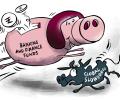
Invest only if you wish to go overweight on the sector.

'Indian families' needs and expectations have gone through a revolution across economic demographics.' 'As this latest Modi-Sitharaman Budget demonstrated, politicians have understood this change. They are responding to it,' points out Shekhar Gupta.

India is likely to attract increasing notice from global investors.

The prime minister, who is on a two-day visit to the state, inaugurated, laid the foundation stone of and dedicated to the nation, railway and metro projects in the state worth Rs 4,500 crore.

President Ram Nath Kovind on Monday said the country's farm production and procurement increased during 2020-21 crop year despite the pandemic and agricultural exports reached a record level of Rs 3 lakh crore during the same period. In his address to the joint sitting of both Houses of Parliament at the start of the Budget session, Kovind said the government is focusing on making the country self-sufficient in edible oils besides making special efforts to promote organic farming, natural farming and crop diversification. "My government is working continuously to empower the farmers and the rural economy of the country... I would like to give maximum credit to the small farmers of the country for this consistent success and strengthening of the agriculture sector," he said.

Young investors could allocate in the proportion of 70:20:10 to equity, debt and gold.
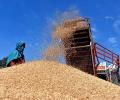
The uptick in prices ranging from steel to wheat could benefit lots of commodity-based companies -- from State-owned SAIL to the agro exporters.

Lower gold imports and higher overall exports to help narrow the gap.

The employment situation remains dire. Whatever can be done to promote greater low-skill employment should be pursued aggressively, advises former chief economic adviser Shankar Acharya.

With palm oil having 55 per cent share in total edible oil imports, the National Mission on Edible Oil-Oil Palm (NMEO-OP) would ensure that farmers get all facilities, from quality seeds to technology to promote cultivation of palm and other oil seeds, he said. Modi made this announcement after virtually releasing the ninth installment of Rs 19,500 crore to 9.75 crore beneficiary farmers under the government's flagship scheme PM-KISAN.

She also took a swipe at the Bharatiya Janata Party over its defeat in the just-concluded Himachal Pradesh assembly elections, saying the ruling party's president could not hold on to his home state. "Who is the Pappu now?" she asked.

'The BJP always said Rahul Gandhi is an 'air-conditioned leader', but after this yatra he has proved them wrong.'

The sharp fall in the rupee's value against the dollar during the July-September quarter, it turns out, has come as a boon for corporate earnings.
